


Electrolysis unit "CHLOREFS"
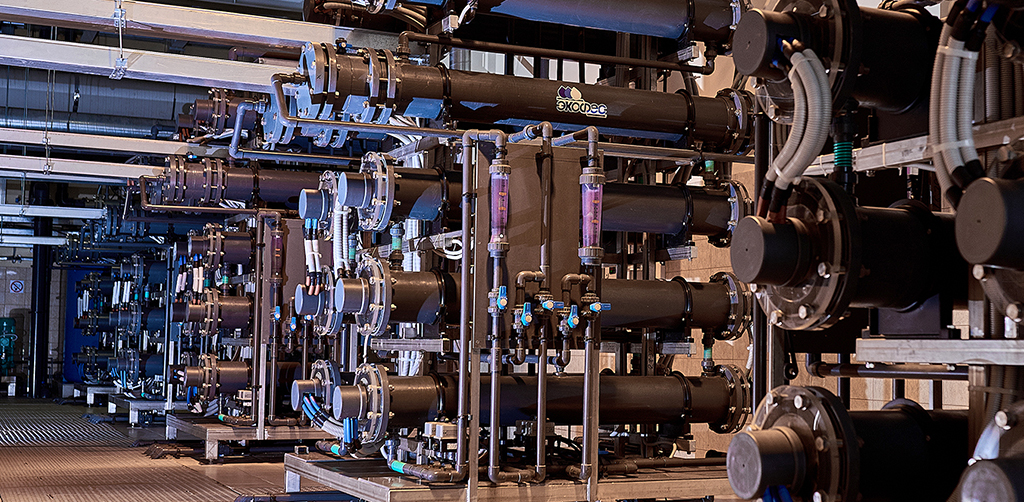
The CHLOREFS electrolysis unit, manufactured by ECOFES LLC, is used for the on-site production of an aqueous sodium hypochlorite solution from sodium chloride (common table salt). The product has an available chlorine (as Cl₂) concentration of 7–8 g/L.
The sodium hypochlorite solution is used for water disinfection and for maintaining water treatment facilities in proper sanitary condition by dosing it into raw water or drinking water in accordance with the approved water treatment and disinfection process scheme.
The on-site production of sodium hypochlorite using CHLOREFS electrolysis units is not classified as a hazardous production facility under applicable regulations.
The unit consists of individual process blocks and includes:
-
a reagent handling system (salt dissolver, bag emptying station, dry salt storage) for preparing saturated brine;
-
an acid-feed decarbonation unit with air stripping of free carbon dioxide (sparging or film degasser);
-
transfer pumps for supplying the decarbonated 3% brine to the electrolyzers;
-
electrolyzers for sodium hypochlorite production;
-
an electrical power supply system (power supply units) for the electrolyzers;
-
control cabinets for the electrolyzers and auxiliary equipment;
-
an acid cleaning unit for the electrolyzer electrode systems;
-
storage tanks for the finished sodium hypochlorite solution;
-
automatic dosing stations;
-
a system for removal, dilution, and atmospheric discharge of hydrogen evolved during electrolysis;
-
a monitoring and metering system for water consumption, electrical energy, sodium chloride (common table salt), produced sodium hypochlorite, as well as brine concentration and discharged hydrogen, including measuring instruments for monitoring these parameters;
-
an automated process control system.
Drinking Water Disinfection in Centralized Water Supply Systems
In a centralized water supply system, drinking water disinfection is a Category 1 process in terms of water supply security.
Therefore, the technological unit responsible for disinfectant production (the electrolyzer and its power supply unit) shall include one redundant (standby) unit to ensure uninterrupted operation in the event of abnormal or emergency events affecting the main operating unit.
The redundant unit shall be connected in parallel with the main unit as follows:
– for 1 to 4 operating electrolyzers — one redundant electrolyzer;
– for more than 4 operating electrolyzers — two redundant electrolyzers.
The redundant equipment ensures technological reliability of sodium hypochlorite production and allows, during periods of epidemiological or industrial risk, an increase in the sodium hypochlorite solution dosing rate by 50–100% in terms of available chlorine (as Cl₂), or the use of reserve capacity for sanitation of tanks, filter units, water mains, and other sanitation activities.
The reagent handling, water decarbonation, and storage process blocks serve all installed electrolyzers, including redundant units.
Main Advantages of Low-Concentration Sodium Hypochlorite
The main advantages of low-concentration sodium hypochlorite (0.8% available chlorine (as Cl₂)), compared with commercially supplied liquid sodium hypochlorite (Grade A, 15% available chlorine (as Cl₂)), are as follows:
– safety (low toxicity, hazard class IV);
– improved storage stability;
– low corrosive activity.
ECOFES LLC provides on-site training for operating and maintenance personnel.
Main Consumables Required to Produce 1 kg of Available Chlorine (as Cl₂)
– sodium chloride (common table salt) of any commercially available grade: 3.5–4.5 kg;
– decarbonated water: 125–140 liters;
– electrical energy: 4.2–4.3 kWh.
The required production capacity of CHLOREFS electrolysis units in terms of sodium hypochlorite output (NaClO) is achieved by the number of standard modules (electrolyzers) operating simultaneously and independently of each other. The capacity of a single module ranges from 1.0 to 1000 kg/day, expressed as available chlorine (as Cl₂).
CHLOREFS Product Range
|
Model |
Available chlorine (as Cl₂) capacity |
Consumption |
|||
|
g/h |
kg/day |
water, m³/day |
salt, kg/day |
electricity, kWh/da |
|
| UG-0.5MK | 40 | 1.0 | 0.14 | 4.3 | 0.002 |
| UG-7 | 190 | 4.5 | 0.6 | 14.4 | 1 |
| UG-7MK | 400 | 10 | 1.4 | 43 | 2 |
| UG-25MK-50 | 2,100 | 50 | 7.0 | 160 | 10.5 |
| UG-25MK-100 |
4,000 |
100 |
14 | 320 | 20 |
| UG-25MK-250 | 10,000 | 250 | 35 | 800 | 52 |
| UG-25MK-500 | 21,000 | 500 | 70 | 1,600 | 105 |
| UG-25MK-1000 |
40,000 |
1,000 | 140 | 3,200 | 200 |
Notes:
- The table presents capacity values under normal operating conditions. Under boost mode, the capacity may be increased by 25–35%.
An electrolysis unit with a capacity different from the standard model range may be manufactured upon request.
In terms of automation level, degree of instrumentation, configuration with dosing pumps, storage tanks, shut-off and control valves, and auxiliary equipment, CHLOREFS electrolysis units are comparable to leading alternatives and, in certain technological aspects, may exceed them.
ECOFES LLC has enabled the use of domestic technical-grade salt by implementing brine decarbonation. This process removes scale-forming bicarbonate ions (HCO₃⁻) through their conversion into CO₂, followed by carbon dioxide removal in a dedicated degassing unit. This approach ensures reliable operation of the electrolysis units when using technical-grade salt and hard water.
The production process of CHLOREFS electrolysis units includes the following stages:
-
decarbonation of tap water used for salt dissolution;
-
preparation of a saturated sodium chloride (common table salt) brine;
-
production of sodium hypochlorite by electrolysis of the brine;
-
dosing of the sodium hypochlorite solution to designated points of the facility’s process flow;
-
scheduled preventive cleaning of unit components.
Function of Main Process Units
The salt dissolver is intended for the preparation and storage of a saturated sodium chloride (common table salt) brine. The prepared brine is supplied by a metering pump to the decarbonated water line, where it is diluted to the operating concentration and fed to the electrolyzer.
The decarbonation unit is intended for the removal of bicarbonate ions from water in order to prevent the formation of hardness scale on the electrodes.
The electrolyzer, of flow-through or circulation type, is manufactured from materials resistant to corrosive media and is equipped with titanium cathodes and MMO-coated anodes (platinum-group metal oxide based). Electrolysis is carried out in automatic or manual mode and is monitored via the control panel.
The power supply unit provides direct current to the electrolyzer electrode system.
The automated process control system (APCS) ensures fully automatic operation of the electrolysis unit and also controls the acid decarbonation process.
Sodium hypochlorite production is accompanied by hydrogen evolution. To ensure explosion and fire safety, gas separators are installed downstream of each electrolyzer. In these separators, electrolytic gases are separated from the solution and discharged via vent piping to the atmosphere outside the building.